
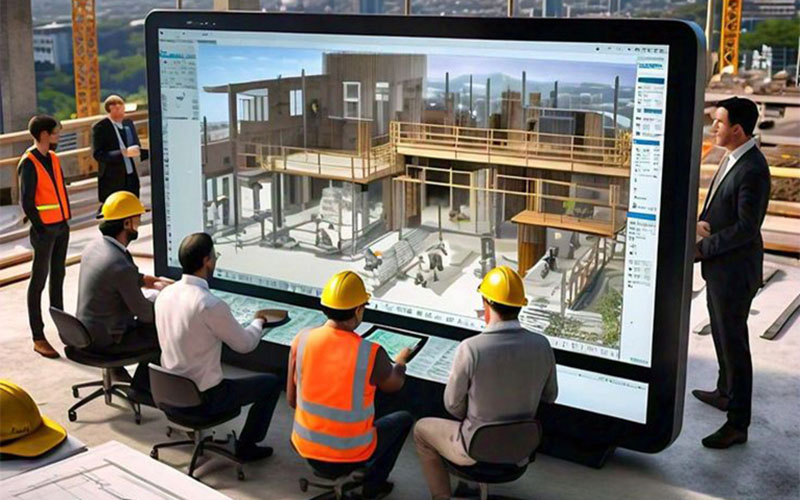
In a control room, space is not empty. It is charged—with intent, with function, with purpose. Every meter is calibrated not for aesthetics, but for attention. The distance between operator and screen, the arc of reach to critical controls, the sightlines across multiple workstations—these are not arbitrary measurements. They are the geometry of focus, a spatial language engineered to support sustained concentration in high-stakes environments.
This geometry begins with a simple truth: human attention is finite. In mission-critical operations, where data flows continuously and decisions carry weight, the environment must minimize distractions and maximize cognitive efficiency. A poorly placed monitor forces the neck to twist, pulling focus away from the task. A cluttered console demands visual scanning, slowing response time. Even ambient reflections or inconsistent lighting can fracture attention over long shifts. Recognizing this, the most effective control rooms are shaped not by square footage, but by human factors.
User-centric design transforms this understanding into physical form. Workstations are arranged to align with natural lines of sight, ensuring that primary data sources fall within the optimal field of vision. Controls are positioned within ergonomic reach zones, reducing physical strain and enabling rapid interaction without repositioning. Furniture is selected not for style, but for its ability to support posture, circulation, and comfort over extended periods. This is not comfort for comfort’s sake—it is operational endurance made tangible.
The precision of this layout is only possible through integrated project management. When spatial planning, ergonomic analysis, software interface design, and hardware installation are guided by a single, cohesive team, the result is harmony—not compromise. The same insights gathered during the initial needs assessment inform the placement of every cable, the angle of every screen, the depth of every console. There are no conflicting priorities, no late-stage surprises, no “we’ll figure it out on-site” moments. Instead, there is continuity: a seamless thread from concept to completion.
This continuity is reinforced by in-house excellence. Relying on a unified team—skilled in engineering, human-centered design, real-time monitoring, and project execution—ensures that technical decisions are always grounded in operational reality. A lighting plan is evaluated not just for brightness, but for its interaction with screen glare. Acoustic treatments are chosen not just for noise reduction, but for their impact on mental fatigue. Even the color of surfaces is tested for its effect on visual contrast and mood. Every choice serves the same goal: preserving the operator’s ability to stay focused, alert, and effective.
And at the core of it all is a commitment to operator well-being—not as a secondary concern, but as a primary design driver. Because fatigue is not merely physical; it is cognitive. Discomfort is not just bodily; it is mental. A room that ignores these dimensions may function technically but fail operationally. Conversely, a space that honors them becomes a silent enabler—allowing operators to channel their full capacity toward interpretation, judgment, and action.
The success of this approach is often invisible. When a control room operates without incident, observers credit the technology or the training. Few consider the spatial intelligence that made consistent performance possible. But operators feel it—in the ease of a long shift, in the clarity of a high-pressure moment, in the quiet confidence that their environment is working with them, not against them.
In a world where data grows louder and systems grow more complex, the geometry of focus offers a counterbalance: simplicity through intention, clarity through design, reliability through human-centered precision. It does not shout. It holds space. It does not dazzle. It enables.
And in that quiet, calibrated space—where every angle, every distance, every surface has been considered with care—the human at the center of it all is free to do what machines cannot: understand, decide, and act with judgment. That is not just good design. It is dependable performance, built into the very walls.