
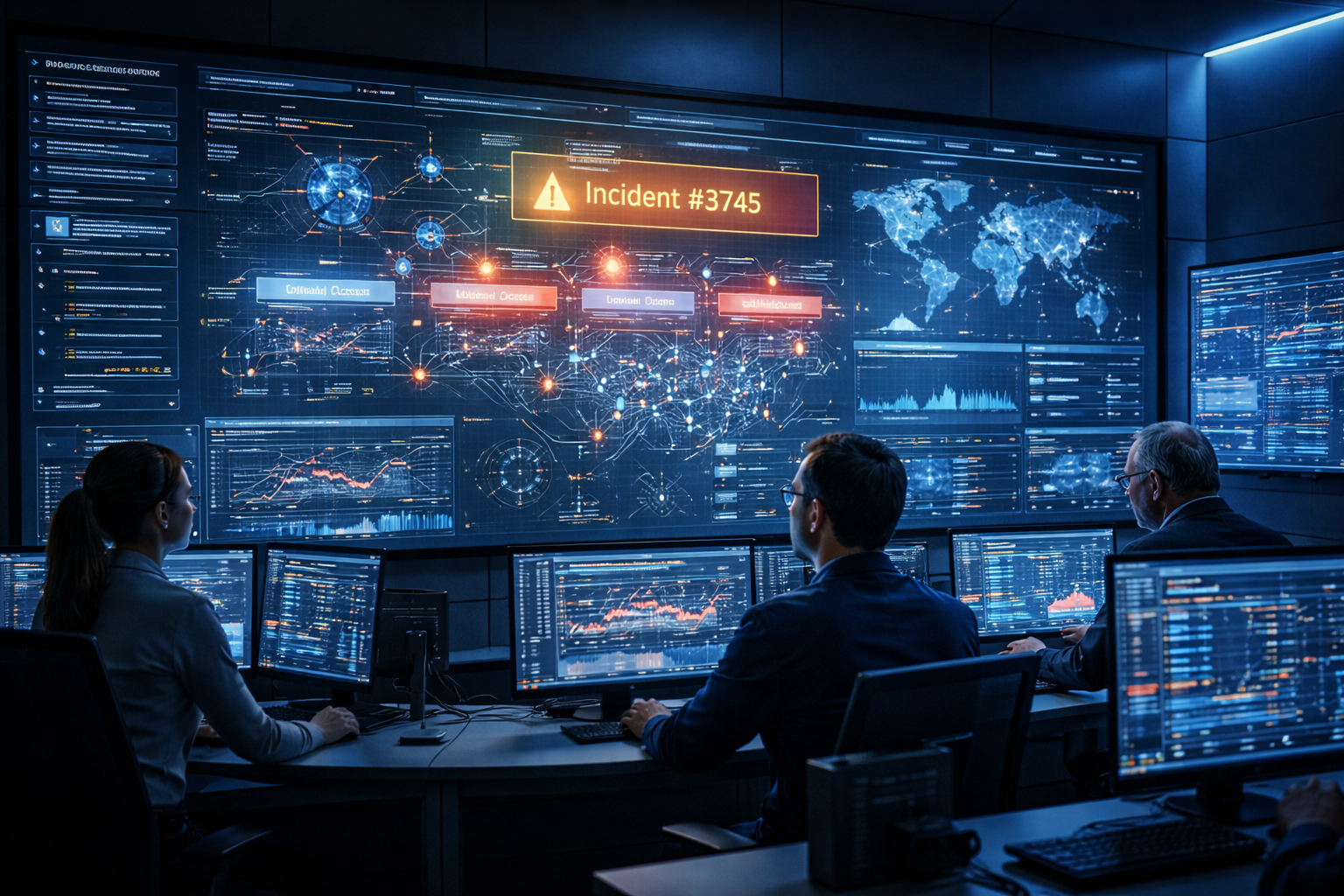
There was a time when cybersecurity was treated as a protective layer — a firewall at the edge, an antivirus system on a device, a reactive alert when something went wrong. It operated in the background, largely invisible, activated only when an incident surfaced. But as digital infrastructure expanded and threat landscapes evolved, that model proved insufficient.
Today, security is not a feature. It is an ongoing operation. And at the center of that operation stands the Cyber Security Operations Room — a dedicated environment designed to detect, analyze, and neutralize threats in real time before they cascade into disruption.
Unlike traditional control rooms that monitor physical infrastructure, a Cyber Security Operations Room oversees invisible terrain. Data flows, network traffic, behavioral anomalies, access patterns, and system vulnerabilities form a constantly shifting landscape. The challenge is not visibility alone. It is interpretation under pressure.
Modern cyber operations rooms are engineered around continuous vigilance. Massive volumes of telemetry stream in from endpoints, servers, cloud environments, and industrial systems. Within that volume, subtle deviations may signal intrusion attempts, lateral movement, or emerging vulnerabilities. The environment must distinguish between harmless irregularities and genuine threats without overwhelming analysts with noise.
Clarity becomes a strategic asset. Visual hierarchies are designed to surface high-risk indicators instantly. Threat intelligence feeds are contextualized rather than simply displayed. Correlated events are grouped into coherent narratives. Analysts are not forced to manually assemble fragmented signals; the system synthesizes relationships before presenting them.
Speed, however, is only part of the equation. A Cyber Security Operations Room must balance urgency with accuracy. False positives erode focus. Delayed recognition increases exposure. The environment therefore relies on structured workflows, incident response protocols, and clearly defined escalation paths. Every action is deliberate. Every alert carries weight.
Collaboration within this room is equally critical. Cybersecurity is rarely a solitary effort. Analysts, threat hunters, forensic specialists, and network engineers operate as a synchronized unit. Shared situational awareness ensures that investigations move efficiently and containment strategies deploy without hesitation. The room becomes a hub of collective intelligence rather than isolated monitoring.
As organizations adopt hybrid infrastructures and cloud-native architectures, the complexity of digital defense grows. The Cyber Security Operations Room evolves accordingly, integrating automation, behavioral analytics, and predictive threat modeling. Artificial intelligence augments human judgment, filtering patterns and prioritizing response without replacing expertise.
In this environment, security shifts from reactive defense to proactive resilience. Threats are not merely blocked; they are anticipated. Vulnerabilities are not discovered by accident; they are systematically identified. Risk becomes measurable, manageable, and strategically reduced.
At its highest level, a Cyber Security Operations Room is not simply a monitoring space. It is a digital shield engineered for constant adaptation. It translates invisible risk into structured action. It empowers analysts to remain calm in the face of complexity. And in a world where digital disruption can escala