
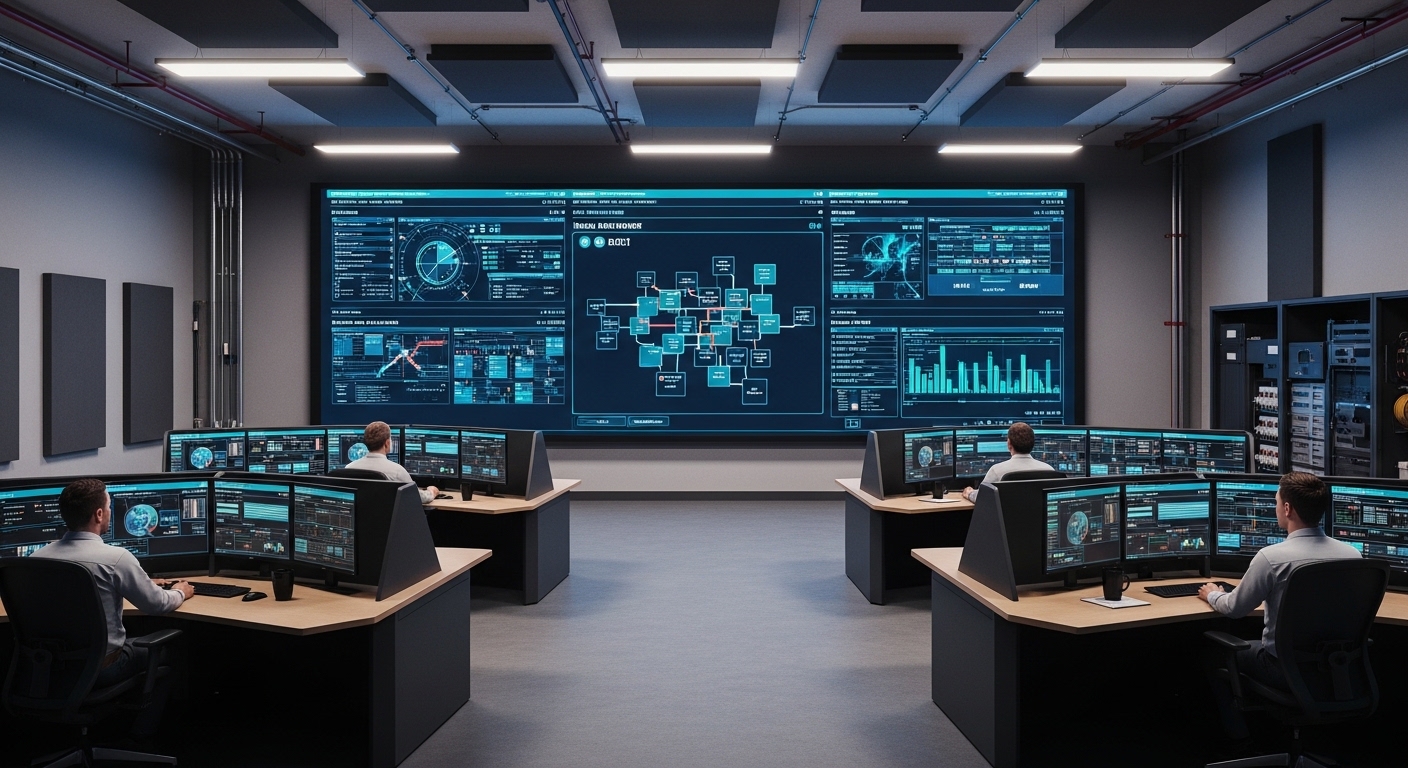
There was a time when a control room was defined by its equipment. Walls of screens, rows of consoles, structured seating, and structured silence. It was perceived as a physical location — a space designed to observe systems and respond when something went wrong. The room itself was the centerpiece, and technology was the measure of its strength.
But as operational ecosystems grew more interconnected and dynamic, the definition of a control room began to shift. It was no longer enough to monitor. It had to interpret. It had to anticipate. It had to support decisions before consequences escalated. The control room evolved from a rea
Modern control rooms operate within layers of complexity. Infrastructure networks span cities. Digital systems generate continuous streams of data. Security risks adapt in real time. In this environment, clarity is not automatic. It must be engineered. Every visual element, every workflow, and every integration point must contribute to a unified operat
The physical layout remains important, but the true architecture lies beneath the surface. A well-designed control room aligns spatial ergonomics with digital intelligence. Screens are not simply installed; they are structured. Data is not simply displayed; it is prioritized. Information flows are carefully mapped to reduce cognitive strain and accelerate comprehension.
At the heart of an advanced control room is situational awareness. Not awareness as raw visibility, but awareness as structured understanding. Operators must grasp system states, dependencies, and emerging anomalies without hesitation. The environment must guide attention naturally, elevating what matters and quieting what does not.
When design fails, complexity fills the gap. Operators shift between fragmented views. Alerts compete for attention. Decision-making becomes slower, heavier. In mission-critical contexts, this friction carries measurable risk. A control room should never amplify uncertainty; it should contain it.
The most effective control rooms feel composed even during disruption. Their strength lies in integration — technology, workflows, human roles, and spatial design working as one system. Lighting, acoustics, display placement, and digital interface structure all contribute to performance. Nothing is accidental. Every detail influences clarity.
As organizations move toward smarter infrastructure, predictive analytics, and interconnected platforms, the control room becomes the operational anchor. It is where data transforms into direction. Where insight becomes action. Where complexity is translated into structured response.
In its highest form, a control room is not merely a room. It is a performance environment engineered for precision. It supports judgment under pressure, sustains confidence in uncertainty, and aligns technology with human capability. In a world defined by real-time change, the control room stands as the center of operational intelligence — not because of how much it shows, but because of how clearly it enables action.